Friday, October 9, 2015

Answering the mystery of turquoise provenance
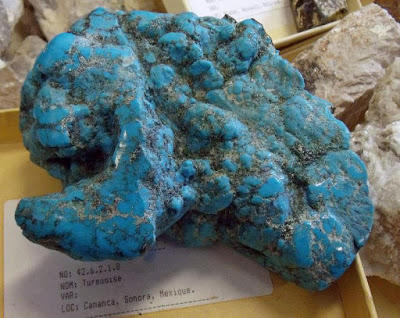
CrediThis is a turquoise sample from Cananea, Sonora, Mexico.
t: Wikipedia; CC BY 2.0
Turquoise has had cultural significance for Native American peoples in the southwestern United States and Mexico for more than a millennium, and turquoise artifacts have been recovered from archaeological sites hundreds of kilometers distant from known sources of the mineral. Evidence for pre-Hispanic turquoise mining has been recognized across much of the southwestern United States and northern Mexico, including as far north as Leadville, Colorado, and as far south as Zacatecas.
Detailed archaeological studies of ancient turquoise mines are rare, and little is known about the timing of their exploitation or the cultural identities of the miners In this study, Alyson M. Thibodeau and colleagues show that many geological sources of turquoise in the southwestern U.S. and northern Mexico can be distinguished from each other through the measurement of lead and strontium isotopic ratios. These isotopic analyses thus provide a new way to investigate the mining and movement of this mineral in prehistory.
Reference:
Isotopic evidence for the provenance of turquoise in the southwestern United States
A.M. Thibodeau et al., Dickinson College, Carlisle, Pennsylvania, USA. Published online ahead of print on 3 June 2015; DOI: 10.1130/B31135.1 Note : The above story is based on materials provided by Geological Society of America

Thursday, January 1, 2015

More Turquoise Info

Turquoise Mining

Two of the main areas for turquoise mining are Arizona and Mexico. Turquoise mines in Arizona include Bisbee Turquoise, Castle Dome (Pinto Valley), Gleeson/Courtland, Ithaca Peak, Kingman, Morenci, Sleeping Beauty, and Turquoise Mountain.Turquoise mining in Mexico takes place mainly in the northern state of Sonora, and its mines include Caridad Mine, Barraca Mine, and Mun. de Baviacora.Also mines in Nacozari and Cananea ,Sonora ,Mexico.Baja California also has produced turquoise.

Processing of Turquoise

Most turquoise has been treated by processes such as plastic bonding, chemical vapor penetration, paraffin, or a different stabilizing agent. It has been estimated that only 3-10% of all mined turquoise is strong enough to be used without some form of stabilizing treatment. If left untreated, the majority of turquoise will soak in chemicals from the environment, causing the color to take on more of a green hue over time.

Many different types of treatments exist for turquoise stones, one of the most common being stabilization. This is the process of hardening the stone, usually by adding a polystyrene plastic resin into its pores, thereby sealing the color of the stone. This process may be substituted by oil or wax treatment, but will result in a far inferior product as the oil and wax do not give permanent results.

Some turquoise may also be color-treated, a process similar to that of stabilization, but with the addition of a color-enhancing dye. Color-treated dye may have a less natural, more plastic appearance. The color infusion process will likely result in a more blue, polished stone.

Treatment may also take the form of reconstitution. In this process, turquoise powder is combined with chips mixed with plastic resin along with coloring agents and then compressed. This type of processing results in a highly unnatural look which only vaguely resembles the natural turquoise stone.

Cutting of Turquoise

Turquoise is often cut into a cabochon in order to be used in various types of jewelry. Cabochon is a term that refers to a gemstone which has been shaped and polished rather than faceted, a technique commonly used on opaque stones, such as turquoise. Turquoise that is cut into a cabochon takes the form of a convex obverse with a flat reverse. This form of cutting also makes the turquoise stone more resistant to scratches and noticeable imperfections of the like. Cabochons are usually cut into an ellipse as the human eye cannot easily observe small asymmetries within this structure as it can with rounded shapes.

The process of cutting turquoise into a cabochon starts with a slab of rough rock and a slab saw, and the shape is stenciled from a template. The slab is trimmed using a trim saw and is then grinded down using diamond impregnated or silicon carbide wheels. The shaping can then be completed by hand by a process known as “dopping,” adhering the stone with hard wax onto a dop stick, which is then ground to the template line. Finally, the top of the turquoise stone is sanded and polished, usually into the shape of a dome.

www.rincontrading.com

Tuesday, December 30, 2014

Why should you buy turquoise?


Turquoise: Blue or Green                


Turquoise the little gem that has  been present in the world for centuries. This gem can be blue, green or greenish blue in color and is made up of a mineral which is the hydrous phosphate of copper and aluminum. This gem is found in various countries but its origins are generally tracked to Egypt. It is also found in Mexico,China and the USA in Arizona.

Now  if  you are wondering  why you should  acquire turquoise,  here is a list of reasons we have compiled just for you.

High Value: Turquoise in the raw form is being depleted at a fast pace. And hence the value is increasing day by day. So if bluish green is your color then start acquiring a lot of turquoise today. The value of this stone has  increased dramatically in the past few years.

Classic Look : Another benefit of buying turquoise is that you can wear it for ages and it is always in style.This gem looks quite classic on anybody. It soothes the eyes and then dazzles them. Turquoise can be worn with any look  and it will only enhance the beauty of whoever wears it.

Multipurpose: The best part about  turquoise is that it is  appreciated by all jewelry lovers . Most commonly it is used to create bracelets, necklaces, pendants and rings. The cool thing is that turquoise jewelry suits both males and females. Females usually go in for more funky and fun filled designs whereas men opt for simplicity. Some people also use this gem to decorate a valued possession like a jewelry box or the headboard of their ancestral furniture.

Cultural Significance: It has been claimed that turquoise acts as a protector for the person who wears it. This gem also attracts prosperity for a person, warns him or her of any upcoming dangers. It is also used as a good luck charm by many people. Some students wear turquoise beads for luck during their examinations and some entrepreneurs wear it while inaugurating a new store or a new business. Turquoise may also shield  you and strengthen the overall body health. Some people are also of the opinion that if you are nearing any dangerous situation, that turquoise would warn you as its color would start fading.

Variety: You can choose a turquoise on the basis of its color. Some of the commonly known types of turquoises that we carry are  from: Arizona -Sleeping Beauty Mine  know for it's blue color and also several localities in Mexico. Including Nacozari-Campitos and Baja locations.


https://www.rincontrading.com/

Monday, September 8, 2014

Peridot a Green Gem


Peridot is a bright green fluorescent stone with an ancient history. The earliest recorded production of Peridot was in about 70 A.D. Peridot Mesa, located on the San Carlos Apache lndian Reservation east of Globe in Gila County, is the most productive locality for peridot in the wodd. Unlike many other gemstones, peridot is usually not treated or enhanced in any way. lt has a very natural beauty, Ancient Romans called Peridot the *evening emerald" because it continued glowing vibrantly at night, even in dim light. Peridot has great metaphysical properties and is said to increase self esteem and aid with letting go of guilt felt frorn past experiences. Because of Peridots sparkling green properties it is a very popular gem used for rings and earings and is also the birthstone for the month of August

http://www.rincontrading.com/peridot-arizona/

Tuesday, September 2, 2014

Azurite-Jerome,Arizona


Azurite is a gorgeous stone found in Jerome Arizona. lt is a mineral form of metallic copper and has a gorgeous blue green color.  The Azurite itself is blue and its green partner is called Malachite. Azurite has been used as a blue pigment for centuries. Mixed with Oil it has a green color and when mixed with egg yolk it turns a green-grey color. The pigment the stone makes is very bright and was used by many medieval painters to achieve very intense blues in their paintings. Often if azurite is found while mining it is a good indicator that there may also be some weathered copper sulfide ores. This stone is said to relieve stress and enhance your inner creativeness. lt is very popular with collectors and is often worn for its metaphysical properties.

http://www.rincontrading.com/azurite-malachite-jerome-arizona-52x39-mm-126-cts-azj2/

Turquoise in Fashion


Turquoise is a beautiful blue stone that can bring intrigue to any outftt. Believed to be a protectant against negative energy,Turquoise is said to bring good fortune to its wearer. The simplest way to wear Turquoise is to pair it with any kind of neutrals such as black and white. Turquoise has graced the necks of Egyptian Pharaohs and adorned the ceremonial dress of early native americans.Wearing this precious stone around your neck can give your outfit a lively pop of color. Weather you are wearing a simple sundress or an intricate blouse a turquoise necklace can be exactly what you need to take your outfit to the next level.